Magic: The Gathering has one of the most nuanced rarity systems in the hobby, and one of the most misunderstood, because in Magic the rarity symbol tells you surprisingly little about what a card is worth. This guide covers every rarity, how to read it from the set symbol, the modern special treatments, and how rarity actually maps to price.
Written and maintained by the TCG Price Lookup data team. We track live TCGplayer market and eBay sold prices across 350,000+ cards, including 168,000+ Magic singles, so the ranges below reflect real 2026 market data rather than guesses.
The Four Core Rarities
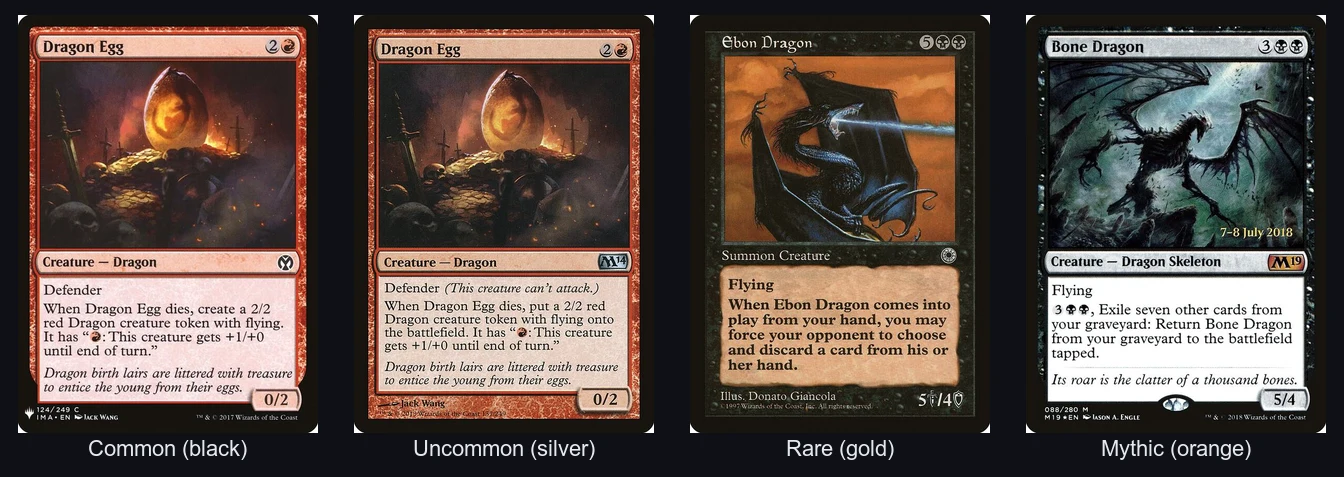
Magic uses four printed rarities, shown by the colour of the expansion (set) symbol in the middle-right of the card:
- Common = black symbol. The bulk of every set.
- Uncommon = silver symbol. A step up, still mostly low value.
- Rare = gold symbol. One or more per pack; where most chase cards sit.
- Mythic Rare = orange / bronze symbol. Introduced in 2008 (Shards of Alara); the rarest slot in a modern pack.
How to Read the Set Symbol
The set symbol sits in the middle-right of the card, between the art and the text box. Its colour is the rarity; the symbol itself tells you which set the card is from.
A few things worth knowing:
- Pre-1998 cards weren't colour-coded. Before the Exodus set, set symbols were a single colour and rarity was determined by the print sheet, not the symbol. For vintage cards, you identify rarity by the set and printing rather than the symbol colour.
- Basic lands are their own thing (functionally common, and near-worthless unless they carry a special art or treatment).
- The collector number (e.g.
234/280) helps you pin the exact card and printing.
The Honest Truth: In Magic, Rarity Is a Weak Predictor of Value
This is the part most guides skip, and it's the most important thing to understand about Magic. Unlike some trading card games, the printed rarity barely predicts price in MTG. What actually drives value is:
- Playability. A Commander, Modern, Legacy or Pioneer staple can be worth far more than a random Mythic from the same set. Plenty of $20+ cards are printed at Uncommon or even Common.
- The Reserved List. Cards Wizards has promised never to reprint (mostly pre-1999) hold enormous value regardless of their original rarity, this is where the most expensive Magic cards live.
- Scarcity and age. Old sets with small print runs command premiums a modern Mythic never will.
- Special treatments. Often the single biggest multiplier (see below).
So when you're valuing a Magic card, the symbol colour is only the starting point. A gold Rare might be worth $0.25 or $250 depending on the four factors above.
Special Treatments and Variants (Where the Money Often Hides)
Modern Magic prints the same card in many versions, at wildly different prices. These treatments are layered on top of rarity:
- Foil (traditional foil and etched foil)
- Borderless, Extended Art and Showcase frame treatments
- Retro frame (the classic pre-2003 border)
- Serialized cards, individually numbered (for example
/500) - The List and Mystery Booster reprints
- Secret Lair drop cards
- Masterpiece Series (Expeditions, Inventions, Invocations), which use MTG's "Special" rarity
- Promos (prerelease, promo pack, buy-a-box) and Universes Beyond crossovers
When you pull a card, the question isn't just "what rarity" but "which version," a borderless foil Mythic and its regular printing can differ 10x in price.
Directional Value by Rarity
Loose 2026 ranges for the base printing of a card, before playability and treatment premiums:
| Rarity | Set symbol | Typical base value | Reality check |
|---|---|---|---|
| Common | Black | $0.05 - $0.50 | Staples and Reserved List commons can hit $10+ |
| Uncommon | Silver | $0.05 - $1 | Format-defining uncommons reach $20+ |
| Rare | Gold | $0.25 - $5 | Chase rares run into the hundreds |
| Mythic | Orange | $1 - $40 | Top mythics and treatments go far higher |
| Special / Masterpiece | Special | $20 - $500+ | Priced on scarcity and demand |
These ranges are directional. In Magic more than any other game, treat rarity as one input, not the answer.
How to Check What a Magic Card Is Worth
Once you know the rarity and the exact treatment, get the live price in about 30 seconds with TCG Price Lookup:
- Search the card at TCG Price Lookup.
- Filter to the correct set (the set symbol tells you which).
- Match the exact printing and treatment (regular, foil, borderless, extended art, serialized, etc.).
- Compare the TCGplayer market price against eBay sold comps.
Start at the Magic price hub, and see the most expensive MTG cards and our MTG price guide for the headline numbers.
A Practical Way to Sort a Magic Collection
From experience going through bulk, the fastest workflow:
- Don't individually price Commons and Uncommons unless they're Reserved List or known format staples. Bulk-sort them.
- Pull every Rare and Mythic for a quick check, plus anything foil, borderless, showcase, retro-frame or serialized regardless of rarity, that's where hidden value sits.
- Check the set symbol colour first, then the treatment. The treatment often matters more than the symbol.
- Flag anything from pre-2000 sets for careful individual pricing; vintage rarity and the Reserved List rewrite the rules.
Final Word
In Magic, the rarity symbol is the beginning of the story, not the end. Read the symbol colour, identify the exact treatment, then check live numbers, because a Common staple can outvalue a Mythic, and a borderless foil can outvalue its plain sibling many times over.
For how rarity works in other games, see our Pokémon rarity guide, Yu-Gi-Oh rarity tiers, One Piece rarity guide and Lorcana rarity tiers. And remember that condition and grade set the final price on anything valuable.
Price ranges in this guide are directional and move with format demand, printing, treatment and condition. Always confirm live numbers at tcgpricelookup.com/mtg-card-prices, where TCGplayer market and eBay sold comps are shown side by side. Last updated July 2026.