
The Black Lotus is the most famous card in Magic: The Gathering, and the most valuable. It's a member of the "Power Nine," it's on the Reserved List (so it will never be reprinted), and a PSA 10 Alpha copy sold for $540,000 in 2021. For a single piece of 1993 cardboard, that's about as iconic as it gets.
But "a Black Lotus" can mean anything from a $540,000 graded Alpha to a $30 joke card called the "Blacker Lotus." The price depends entirely on which edition you have and what condition it's in. This guide breaks down every version so you know exactly what yours is worth.
How to Identify Which Black Lotus You Have
Before you can value it, you need to know which printing you're holding. Check these in order:
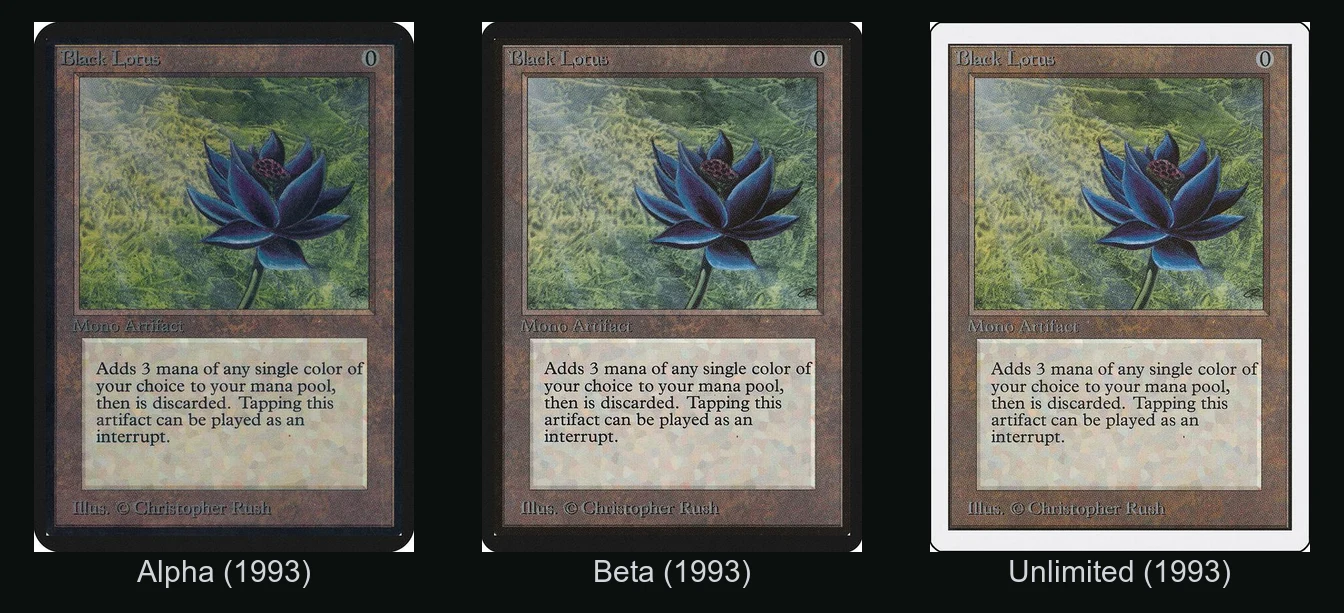
- Border color. Alpha and Beta have a black border. Unlimited has a white border. This is the fastest first split.
- Corner rounding. Alpha corners are noticeably more rounded than Beta. Beta and Unlimited have sharper, smaller corner radii. Alpha is the only edition with that distinctive heavy rounding.
- The card back. A real Alpha/Beta/Unlimited card has the standard Magic back. Gold border + square corners = Collector's Edition / International Edition (not a real tournament card, see below).
- Copyright line. Beta and Unlimited added a copyright line at the bottom that Alpha lacks. Combined with corner rounding, this confirms Alpha vs. Beta.
- Read the name carefully. "Blacker Lotus" is an Unglued joke card, not a real Black Lotus.
If your card has a black border, heavily rounded corners, and no copyright line, you may be holding one of the most valuable cards in the hobby. Get it authenticated before doing anything else.
Alpha Black Lotus Prices
Alpha was the first-ever print run of Magic (1993), with a tiny print quantity. Alpha is the most valuable edition by a wide margin.
PSA 10 (Gem Mint): $400,000 – $600,000+ PSA 9 (Mint): $120,000 – $250,000 PSA 8 (NM-Mint): $50,000 – $90,000 PSA 7 (Near Mint): $28,000 – $50,000 Raw (ungraded), Near Mint: $35,000 – $80,000 Raw, Lightly Played: $22,000 – $38,000 Raw, Heavily Played: $14,000 – $22,000
PSA 10 Alpha Lotuses are essentially population-of-a-handful cards, which is why the ceiling is so high and why every sale makes news.
See live prices: Black Lotus, Alpha Edition →
Beta Black Lotus Prices
Beta followed Alpha later in 1993 with a larger (but still small) print run and slightly refined corners. It carries most of Alpha's prestige at a meaningfully lower price.
PSA 10 (Gem Mint): $150,000 – $300,000 PSA 9 (Mint): $55,000 – $120,000 PSA 8 (NM-Mint): $24,000 – $45,000 PSA 7 (Near Mint): $14,000 – $24,000 Raw, Near Mint: $18,000 – $35,000 Raw, Lightly Played: $10,000 – $18,000 Raw, Heavily Played: $7,000 – $11,000
Beta is the sweet spot for many high-end collectors: black-bordered, vintage, and iconic, without the Alpha population premium.
See live prices: Black Lotus, Beta Edition →
Unlimited Black Lotus Prices
Unlimited (1993) was the first white-bordered print run and had a much larger quantity. It's the most "attainable" real Black Lotus, though "attainable" still means five figures.
PSA 10 (Gem Mint): $30,000 – $60,000 PSA 9 (Mint): $12,000 – $22,000 PSA 8 (NM-Mint): $7,000 – $12,000 PSA 7 (Near Mint): $4,500 – $8,000 Raw, Near Mint: $6,000 – $12,000 Raw, Lightly Played: $4,000 – $7,000 Raw, Heavily Played: $2,500 – $4,000
Most Black Lotuses that surface from old collections are Unlimited copies in played condition, placing them in the $2,500–$7,000 range.
See live prices: Black Lotus, Unlimited Edition →
Collector's Edition & International Edition ("the gold-bordered ones")
This is the single biggest source of confusion. Collector's Edition (CE) and International Edition (IE) were boxed sets that included a Black Lotus with a gold border, square corners, and a different back. They are not tournament-legal and are worth a fraction of a real Lotus.
Collector's Edition / International Edition Black Lotus: $150 – $500
If your "Black Lotus" has square corners and a gold border, this is what you have. It's a fun collectible, not a $20,000 card.
See live prices: Black Lotus (CE), Collector's Edition → · Black Lotus (IE), International Edition →
"Blacker Lotus" (Unglued, 1998)
Searches for "blacker lotus price" are common, so to be clear: the Blacker Lotus is a parody card from the joke set Unglued. It's a real, fun card, but it has nothing to do with the original Black Lotus.
Blacker Lotus (Unglued): $15 – $40
PSA & BGS Graded Price Tiers Explained
For a card this valuable, the grade is everything. Here's roughly how each grade relates to the PSA 10 price:
| Grade | Description | Price vs. PSA 10 |
|---|---|---|
| PSA / BGS 10 | Gem Mint. Perfect or near-perfect | 100% |
| PSA / BGS 9 | Mint. One minor flaw | 30–50% |
| PSA / BGS 8 | NM-Mint. Light wear or centering | 15–25% |
| PSA / BGS 7 | Near Mint. Visible wear, no damage | 8–15% |
| 6 and below | Significant visible wear | Below 8% |
A BGS 9.5 with high subgrades can trade above an equivalent PSA 9, and "black label" BGS 10s command the strongest premiums of all. For vintage cards like Lotus, centering and surface are usually the hardest subgrades to hit. If you're comparing graders, see our PSA vs. BGS vs. CGC comparison.
Why Is Black Lotus So Expensive?
A few structural reasons keep the floor high:
- It's on the Reserved List. Wizards of the Coast has committed to never reprinting Reserved List cards, so supply is permanently fixed. No reprint risk means no ceiling compression.
- It's a "Power Nine" card. Black Lotus produces three mana for zero cost, the most broken effect in the game's history. It's banned or restricted in nearly every format, which is part of its legend.
- It's the face of Magic. It's the card non-players recognize. That cultural status drives demand far beyond the competitive community.
- Vintage supply only shrinks. Every graded copy locks a card out of circulation, and damaged copies get harder to find in higher grades over time.
For the broader picture of high-end Magic prices, see our guide to the most expensive MTG cards.
How to Check a Black Lotus's Value Right Now
The fastest, most accurate way to value a specific Black Lotus is TCG Price Lookup:
- Go to TCG Price Lookup and search "Black Lotus"
- Select the correct edition (Alpha, Beta, or Unlimited)
- Match your card's condition, or the PSA/BGS grade if it's slabbed
- Compare the TCGplayer market price against eBay sold comps side by side
Because the tool shows actual eBay completed sales, not just asking prices, you see what buyers really paid, which matters enormously at this price point. For why those two sources can differ, read TCGplayer vs. eBay prices.
Tips for Selling a Black Lotus
- Authenticate first. At these values, fakes and altered cards are common. Never buy or sell raw without expert authentication.
- Grade anything you intend to sell. Buyers at four and five figures expect a PSA or BGS slab. The grading fee is trivial relative to the value.
- Don't sell raw on a whim. The gap between, say, a raw "Near Mint" Unlimited and a PSA 9 can be thousands of dollars. Get it graded and let the market set the number.
- Compare against live sold data on TCG Price Lookup before accepting any offer; dealers commonly offer 50–70% of true market value.
Final Thoughts
A Black Lotus can be worth anywhere from $30 (Blacker Lotus), to a few hundred (Collector's Edition), to over half a million dollars (PSA 10 Alpha). The single most important step is identifying exactly which version you have, border color, corner rounding, and card back tell you almost everything.
Once you know your edition and condition, search it on TCG Price Lookup to see live TCGplayer and eBay prices side by side. It's free, takes 30 seconds, and gives you real transaction data instead of guesses.
Check live Magic: The Gathering prices, every set, every printing, every grade, at tcgpricelookup.com/mtg, with TCGplayer market and eBay sold comps side by side.