The One Piece Card Game is young (it launched in 2022) but its rarity system already runs deep, and it's the first thing to check when you want to know what a card is worth. The good news: every card tells you its rarity with a short letter code. Learn the codes and you can sort pulls in seconds and spot the chase cards instantly.
This guide covers every One Piece rarity, what the code looks like, and how each tier maps to value, plus the single most important thing most guides skip: why the artwork often matters more than the rarity letter.
How to Read the Rarity on a One Piece Card
Two markings tell you almost everything:
- The rarity code, printed on the card (near the card number), is a short letter abbreviation:
C,UC,R,SR,SEC,L,P,TR. - The card number, like
OP01-001, tells you the set (OP01) and the card's slot in it. Leaders are usually the lowest numbers in a set.
That's it, no symbols to memorize, just the letters.
Every One Piece Rarity Tier
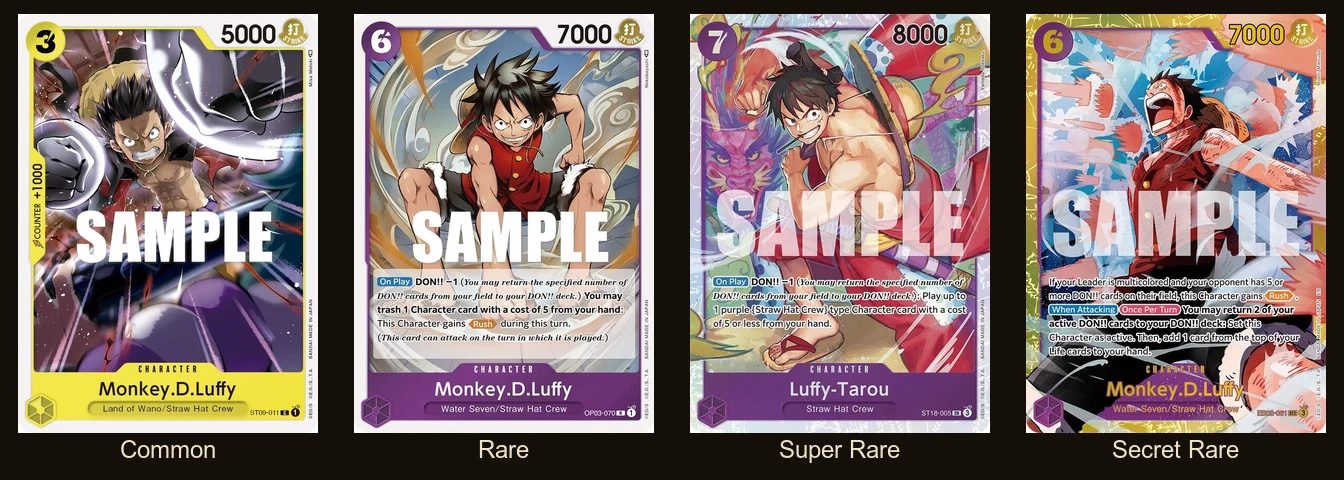
Here's the full ladder, using the same rarity names you'll see in TCG Price Lookup, with 2026 value ranges (base printings, before alternate-art premiums):
| Code | Rarity | What it is | Typical value |
|---|---|---|---|
| L | Leader | The card your deck is built around, one per deck | $0.15–$30 (alt-art leaders far more) |
| C | Common | The bulk of every pack | $0.05–$1 |
| UC | Uncommon | A step up, still mostly bulk | $0.05–$2 |
| R | Rare | Standard rare, some playable staples | $0.10–$5 |
| SR | Super Rare | Foil chase of most sets, big characters | $1–$30 |
| SEC | Secret Rare | The top pull of a set, rainbow/secret foil | $10–$150+ |
| TR | Treasure Rare | Premium textured rarity introduced recently | $40–$200+ |
| P | Promo | Event, pack-in and tournament cards | $0.20–$500 |
And one that isn't a creature card at all:
- DON!! cards are the resource cards every deck uses. Standard DON!! is worthless in bulk, but special-art and promo DON!! cards (tournament prizes, alternate illustrations) can run from a few dollars into the hundreds.
The Real Value Driver: Artwork, Not Just the Letter
Here's the part that trips people up. In One Piece, the same rarity can be worth a few dollars or a few thousand depending on the art treatment:
- Base art (the standard printing) follows the value ranges above.
- Alternate Art (AA) versions of Super Rares and Leaders carry big premiums.
- Manga rares (comic-panel art) are among the most sought-after cards in the game.
- Parallel / special foils add another layer on top.
The spread is dramatic: a Super Rare can sit at well under a dollar in its base printing, while the manga or alternate-art version of a chase character trades into the thousands. So when you pull an SR or a Leader, the question isn't just "what rarity is it," it's "which art is it." Always match the exact printing when you price it.
Leaders, Explained
Every One Piece deck is built around a Leader card (code L). Most leaders are cheap, but alternate-art and tournament-promo leaders of popular characters (Luffy, Zoro, and friends) are some of the format's biggest chase cards. If you pull an alt-art leader, check it carefully.
How Rarity Maps to Value
A few rules of thumb:
- C, UC and most R are bulk, sort them by set and move on unless they're playable staples.
- SR and above are worth individually checking, and the alt-art/manga versions are where the money lives.
- Secret Rare (SEC) and Treasure Rare (TR) are the designed top-of-set chase tiers.
- Condition and grade still set the ceiling. A clean, well-centered SEC graded gem mint can be worth multiples of a raw copy, see trading card conditions explained.
How to Check What Your Card Is Worth
Once you've read the rarity and identified the exact art, get the live price in about 30 seconds with TCG Price Lookup:
- Go to TCG Price Lookup and search the character or card.
- Filter to the correct set (the card number's prefix, e.g. OP07).
- Match the exact rarity and art (base, alternate art, manga, parallel).
- Compare the TCGplayer market price against eBay sold comps.
It pulls live data from both TCGplayer and eBay completed sales, so you see what copies actually trade for. Start at the One Piece price hub.
Quick Cheat Sheet
- Read the letter code: L, C, UC, R, SR, SEC, TR, P.
- C / UC / base R = bulk; SR and up = check it.
- The art (alternate art, manga, parallel) can multiply the value 10x to 100x over the base printing.
- Alt-art Leaders and manga rares are the format's blue-chip chase cards.
- Rarity is the first clue; condition and grade set the final price.
For the headline numbers, see the most expensive One Piece cards and our One Piece price guide. For how rarity works in other games, see the Pokémon rarity guide, Yu-Gi-Oh rarity tiers and Lorcana rarity tiers.
Check live One Piece Card Game prices by set, rarity and art at tcgpricelookup.com/one-piece-card-prices, with TCGplayer market and eBay sold comps side by side.